
Fibromyalgia pain may respond to different drugs. However only 40 - 60 % of people with fibromyalgia notice the drugs decrease their pain. Those who do see a decrease, experience a reduction of 25-40%. These results are partly due to the beneficial effects of the drug and its side-effects on the person taking the drugs. The individual’s tolerance will determine their ideal dose.
Combining two drugs that work differently may result in better pain control and at lower doses than when either of the drugs are used alone. The authors predict that combining one pain-relieving drug (pregabalin) that has central nervous system side effects (for example, drowsiness, dizziness,) with a drug that does not have the same side effects (alpha-lipoic acid) could result in better pain relief and less side effects.
Titre de l'article
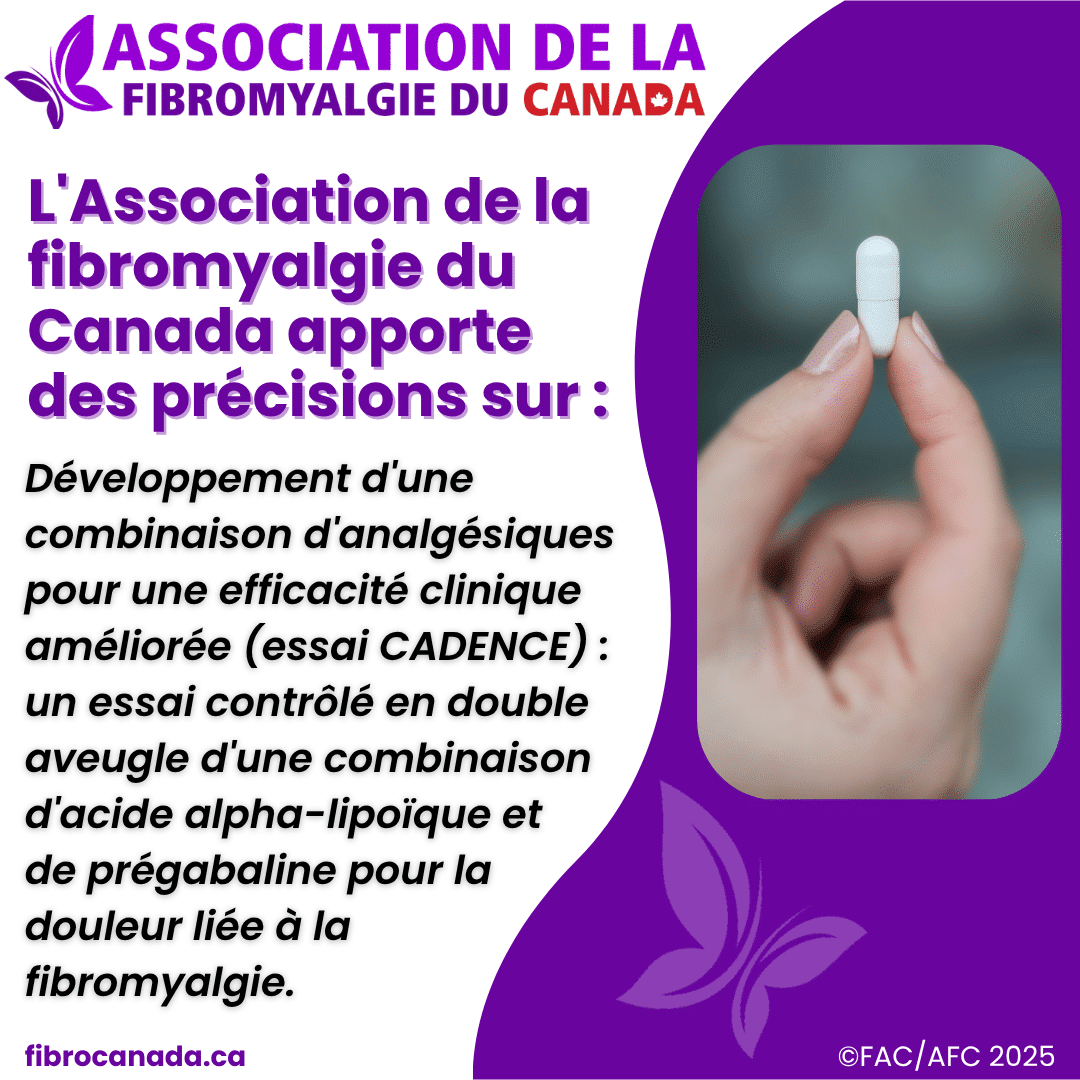
Développement d'une combinaison d'analgésiques pour une efficacité clinique améliorée (essai CADENCE) : un essai contrôlé en double aveugle d'une combinaison d'acide alpha-lipoïque et de prégabaline pour la douleur liée à la fibromyalgie.
Date de publication 2023
Journal Citation
Gilron I et al. Combination analgesic development for enhanced clinical efficacy (the CADENCE trial): a double-blind, controlled trial of an alpha-lipoic acid-pregabalin combination for fibromyalgia pain. PAIN 2023;164(6):1783-1792. https://pubmed.ncbi.nlm.nih.gov/36877492/
Contexte
Fibromyalgia pain may respond to different drugs. However only 40 - 60 % of people with fibromyalgia notice the drugs decrease their pain. Those who do see a decrease, experience a reduction of 25-40%. These results are partly due to the beneficial effects of the drug and its side-effects on the person taking the drugs. The individual’s tolerance will determine their ideal dose.
Combining two drugs that work differently may result in better pain control and at lower doses than when either of the drugs are used alone. The authors predict that combining one pain-relieving drug (pregabalin) that has central nervous system side effects (for example, drowsiness, dizziness,) with a drug that does not have the same side effects (alpha-lipoic acid) could result in better pain relief and less side effects.
Qui a participé à l'étude ?
Canadian adults who met the 2016 diagnostic criteria for fibromyalgia and were in moderate pain (scoring 4 or above on a numeric pain scale) on a daily basis were recruited. Participants were able to continue drug and non-drug management strategies that were already routine to them.
Comment l'étude a-t-elle été menée ?
There were 41 patients (4 male, 37 female) randomly put into 3 groups during the trial, with 24 patients completing all three treatment options.
Each participant who completed the trial took pregabalin alone, alpha-lipoic acid (ALA) alone or pregabalin with ALA. Each treatment period was 6 weeks long including slow increases to maximum tolerated doses and then a dose taper followed by a no study drug period in between each treatment. Participants then returned to try a different treatment option until they had tried all three options. Neither the patients nor the research personnel knew what treatment the patient was taking.
Résultats
There also were no significant differences between the 3 groups for the improvement in pain.
The mental health component score was significantly better for pregabalin alone or in combination, compared with ALA alone. Scores were significantly different indicating less sleep disturbance and improved mood for pregabalin alone or in combination, compared to ALA alone.
Each individual took similar doses of pregabalin and ALA whether they were used alone or whether they were used in combination. However individual dosing may have been different from participant to participant.
At least 5% of participants reported side effects when increasing the dose, but these were not common at the highest tolerated doses or when reducing or stopping the medication
Side effects such as drowsiness and cognitive dysfunction were more frequent with pregabalin compared to ALA. Abnormal gait ( a different walking pattern than their normal) was more frequent with pregabalin plus ALA, compared to ALA alone.
Limites de l'étude
The COVID pandemic created difficulties in recruitment of patients and only 41 of the 54 planned patients started the study. The brief treatment durations used in the trial may have impacted the results.
Conclusions
The results do not support any benefits of combining pregabalin with ALA for the treatment of fibromyalgia pain. The results should be interpreted with caution because of the small number of participants.
The ability to reach similar doses of pregabalin and ALA without increased side effects supports future study of potentially more helpful drug combinations that have different side effect profiles.
Article summarized by FAC Research Committee 2025
For more information consult the original article
Pain. 2023 Aug 1;164(8):1783-1792. doi: 10.1097/j.pain.0000000000002875. Epub 2023 Mar 6. https://pubmed.ncbi.nlm.nih.gov/36877492/
 FR
FR  EN
EN