
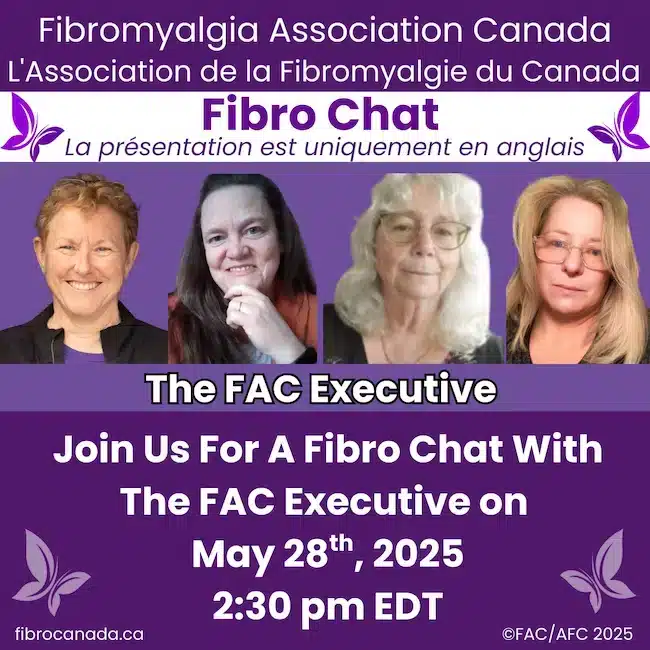
Discussion sur la fibromyalgie avec les membres exécutifs de la FAC
(in English with French captions)
Join the FAC Executive as we reflect on the May 20th Round Table Panel Discussion. We'll review some of the key responses and explore perspectives from those with lived experience.
Whether you're newly diagnosed or have been living with fibromyalgia for years, this session will offer valuable insights and practical tools to help you thrive.
Restons connectés, ce mois-ci et tous les mois.
Cette séance est offerte en anglais sur Zoom, avec la possibilité de visionner les sous-titres dans la langue de votre choix. Pour savoir comment visionner les sous-titres dans une autre langue, cliquez ici consultez notre tutoriel précédent.
Tenu le 28 mai à 14h30 HE
Jetez un oeil au replay ci-dessous
Transcript:
Thank you, everyone, for coming. I’d like to welcome you to the executive fibro chat for Fibromyalgia Awareness Month. We’re going to be talking about the round table that occurred on Monday, May 20th, and we’re going to discuss resilience, how we see it, and thoughts we had based on the presenters on Monday, who were Tyler Dillman, a physiotherapist, Dr. Andrea Furlan, a physiatrist, and Eleanor McGory, a psychologist.
That discussion was very well received, and we thought it would be nice if we added the patient voice to that. I’m going to begin by acknowledging that we are on the traditional and unceded territories of the Indigenous peoples across Canada: First Nations, Métis, and Inuit. We would like to honour their enduring connection to the land and are committed to fostering respectful and meaningful relationships with all Indigenous communities. I would like to acknowledge and give thanks to the land on which we live, work, and play, and the people who have cared for it. I am speaking to you from Mi’kma’ki, the ancestral and unceded territory of the Mi’kmaq people in Nova Scotia. We are all treaty people.
First, we’re going to introduce ourselves because this is the executive FAC chat. My name is Trudy Flynn, and I am the chair of the board of Fibromyalgia Association Canada. I have lived with fibromyalgia for over 30 years, and I live just outside Halifax, Nova Scotia. I’ll turn it over to the vice chair of FAC. Go ahead, Sherry.
I am Shery Wasdal. I am out in the Calgary, Alberta area, and I have had fibro since I was a teenager, but I wasn’t officially diagnosed until around 2019. Thank you.
My name is Mary Delaney, and I live in Kingston. I’m the secretary to the board of directors for FAC, and I’m also on the education committee. I was diagnosed with fibromyalgia in 2015, but I went off work due to it in 2013, so that’s how long I’ve had fibromyalgia.
I’m Maggie O’Brien. I’m from Windsor, Ontario. I’ve been ill for quite a while, including while working. Around 2018, I was officially diagnosed after a long series of visits with doctors trying to sort things out. Then I was forcibly retired from work. I am the treasurer, and I’m also the advocacy chair. I enjoy working with FAC, finding our community, and supporting one another while we go through this chronic illness.
Thank you, everybody. Sherry is also on the education committee, and she is our web developer. I am an ex-officio member of all the committees, but I chair the education, awareness, and research committees.
Let’s get started. One of the things we asked our presenters was what they thought the definition of resilience is. Did you agree with their definitions? Do you have your own definitions? What do you think?
Well, this is where I bring my prop in because when we were talking about strength and resilience, it reminded me of an elastic. When you think about resilience, here’s an elastic being stretched beyond its original place, and when I let it go, it snaps right back. That’s a little bit of an example of what resilience is. It’s the ability to snap back, to adapt to what’s happening in your life. It can be expressed in a lot of ways, but one way to think about it is the ability to adapt to changing circumstances. These are big circumstances in our lives. That’s how I see resilience: being able to snap back and adapt to the things that are changing in our lives.
I recall Dr. Furlan’s example where she used a piece of paper and I think a piece of leather or something like that, and how you were able to crumple them up. I thought it was such a good analogy for resilience. Paper can be flattened out and straightened out again, but it takes way more effort to get it back to its original shape than it did before. I feel that fibro is very much the same way. It takes a lot of effort to get it back to normal, to get it back to where it used to be. I thought that was a really good analogy too. And Mary, yours is really the stretch. We do get very stretched. So both are good explanations of resilience.
I liked Eleanor’s example when she talked about the willow tree and the oak tree, and how the willow tree can bend and that makes it very resilient. It just bounces back. Whereas the oak tree, if enough wind or enough stress hits it, it breaks. Maggie, what about you?
Eleanor discussed bamboo and how you bend and stretch and accommodate the wind or the changes. At first it was difficult for me to grasp. I understand the term resilience. I understand that we have to be very tough and endure this chronic illness. But I never really put it into words until Eleanor explained it, because sometimes with us words can feel like lip service. But when Eleanor explained resilience and then connected that conversation to using somatic work to get your body to calm down, that’s when it clicked for me. For me, it’s all about fight or flight. That’s my wording for it, and how to get your body to calm down.
That’s when it clicked, because I know we’re all tough. I know we all deal with this and try to get our fibro back to normal, manageable, and acceptable. It’s strange that we think that way, but it’s true. When you’re dealing with a chronic illness, at some points you can deal with it. When I’m in a flare, I’m in a crisis. I lose that ability and actually forget that I’m going to be fine, that I’m going to get through it, that this is going to pass. The hard part for me is thinking about the term resilience. I think more about how I get out of fight or flight, how I get through this crisis and make myself more comfortable.
So, for people who might be watching this and think those are just terms or lip service, we stretch that language to work for us. Fibro is very variable for everybody, and so are our coping methods. We use a wide variety of coping methods. But when Eleanor used the word somatic and talked about singing, vibration work, breathing exercises, and grounding exercises, that showed the variety of techniques we use to get this not in control, because it never really is, but to get it to a place where we can deal with it and make it more acceptable.
The big part of resilience for me is giving yourself permission, when you are not feeling resilient, to rest and not feel guilty. Because guilt will make it harder to get through it calmly and quickly.
That’s really interesting, Maggie, because the bugs in our area this year are crazy and we have not had very much sunshine. At lunchtime I thought I was going to go out and enjoy the sun while we had it. I even wore a bug net over me. Apparently tomorrow we aren’t going to have sunshine, and we only had it yesterday and today. I went out, and when I came back in, somehow the bugs got on my clothes or into my hair. If I didn’t have makeup on, you could see the bug bites. This year, for some reason, I’m reacting to them. I reacted badly, and they were in my hair and everywhere when I got back in the house. I thought, I am not going to be able to think coherently during this presentation.
Then I thought of what Eleanor said about singing or chanting. So I turned on my music and started singing, and that helped. I was really surprised. I have never used that technique before to make myself feel better. So there I am singing away, and Natasha comes in and says, “Are you late for this presentation?” But the whole point is that it really helped. It helped not just my fibromyalgia; it even seemed to help the allergic reaction. I put that technique into action.
Same thing for me. I had forgotten that she talked about singing, and I remember at the time of the presentation thinking, oh yeah, I used to do that. Years ago, I worked in the restaurant industry and it was hardcore. It was so busy and crazy. I remember singing at the top of my lungs as I went into the kitchen, and the cooks thought I was crazy. But I was singing because it helped me ground myself, relax, and have some fun. It was busy, but it was going to be okay. If I could still sing, I was going to be fine. I forgot about that, so thanks for bringing it up again.
That was great, and I think it’s a very practical thing. Just put your headphones on, turn up the music, and away you go. But it’s not just about being positive or all sunshine and rainbows. She explained, and I’m roughly quoting her, that the vibration brings down your cortisol. When we are in those moments, which I call a crisis, whether it’s MCAS, fibro, or all those things, bringing down those levels and calming the system helps reduce how we react to it all. That was the key thing where I finally understood where they were going with this. It took that explanation of the somatic process for me. I’m not super scientific.
Trudy likes the research. For me, I don’t like when people pay lip service. But they weren’t doing that. They were giving us techniques and telling us to use a wide variety.
That leads me to my next point. Tyler Dillman said, and I give them a lot of credit for this, that he acknowledged how difficult and challenging fibro is to cope with and live with day to day. He also said that movement and exercise are hard to digest when you are in so much pain. To get that recognition from the field is huge. Not just from Tyler, but from Andrea and Eleanor too. To hear that it is real, not in your head, and that it is challenging and difficult, was huge. Dr. Furlan said that it is an invisible disability and a chronic disease. We do not get enough recognition for this. I was elated to hear that recognition from them, from the other side of the table, to hear that they really get it and understand how difficult day-to-day life can be, especially with the episodic nature of it.
It’s interesting about the singing because I have experience with dementia. I worked with dementia patients before I had to retire, and my mom had Alzheimer’s. Singing is something we used with dementia patients who were in a crisis, which was common. We would turn music on or sing, and it was absolutely amazing to watch someone who didn’t even recognize their own children calm down and become peaceful. It really does work. If it can work at that level, where people have lost their cognitive abilities and their memories, then it’s kind of a no-brainer that it’s going to work for people like us. But I never really thought of it as a therapeutic device. It’s interesting, and I think it’s important having presenters like them, because maybe I should have realized that before, but I didn’t.
What I would say is that when it comes to strength and resilience, and the purpose of these things, what the somatic work does is get our bodies to a place where we are calmer and more able to deal with things, as opposed to being too disabled to deal with them. That’s a huge part of fibromyalgia, the disability piece. Eleanor said that resilience can be built, and that high levels of pain can take away our ability to feel joy and find meaning in our lives. But if we can look to these other ideas, these things we can incorporate into our lives, such as singing, mindfulness, or meditation, they are going to help us overall.
There is a lot to adjust to here because we go from a place where we can do things to a place where there are so many things we can’t do now. When we look to our strengths, we can try to figure out where the things are that we still can do and what we can do to make it a little bit better, because that’s what it’s about—trying to make things a little bit better for ourselves. A cure would be lovely, but being able to deal with it in a better way is valuable too.
I agree with you, Mary. It’s about dealing with it day to day, and that’s what’s important—learning how to manage day to day. So we’re all going to be singing in the shower, singing while we’re cooking, and singing while we’re vacuuming.
There were a lot of suggestions and ideas that came out of that round table. One particular thing that Tyler spoke about was movement. We know movement is such an important component of making ourselves feel better, but with fibro, it’s so tough. One of the amazing things he said, which finally clicked for me, was that we need to go low and slow. We need to gradually add movement back and build up trust with our bodies again, but also understand that it’s a long game.
The way he phrased it was, “It’s like stacking paper.” I thought, yes, exactly. I know, Trudy, you used to run marathons. I never did that. I hated running. But maybe the solution for me is starting with walking for three minutes. Some people might say, why even bother, it’s only three minutes. But because that’s where I need to start. That is the place I am at. That’s my first piece of paper. Maybe tomorrow it’s four and a half minutes. Maybe next week it’s five and a half. And maybe the week after that a wind blows through and my stack of paper gets knocked over and I have to start again. But that willingness to accept that that’s what I can do, and that some movement is better than zero movement, was such an impressive suggestion from Tyler.
He also mentioned the marathon analogy. I told you the story about the man here in Halifax who used to run marathons and win them all. His wife had triplets, and he decided that year he wouldn’t spend all summer and winter training for marathons because he was needed at home. So he thought, I run
marathons, I can just run a 10K. After he ran the 10K, which he did not win by a long shot, he was shocked. He said he started the race at his usual marathon pace, which is slow because you have to pace yourself if you want to finish. By the time he realized that running a 10K is not the same as running 42K, everyone was gone and he was at the back end of the middle of the pack.
This was a man who never lost a race, so he realized marathon training did not guarantee him a win. If you’re running 10K, you’re running faster. If you’re running 5K, you’re running even faster. Those are the races where sprinting happens, and he was not a sprinter. He was the slow and steady type. He didn’t adjust. I thought that was a really good analogy by Tyler. We’re in the marathon, and we have to adjust because we’re not out there running the 5K sprint or the 10K sprint. We are the marathoners. Life is different for us.
I can say from personal experience that in the last four or five years, with POTS, fibro, and my other comorbidities, last year toward the end of the summer I got into a warm pool. I went from being pretty seized up all the time, with that coat-hanger pain in the traps, to getting into the warm pool every day for about an hour and just moving however I could. I always had music going outside and had no intention of doing anything major other than just getting in the pool and moving. Whether it was walking back and forth, floating, or stretching, I didn’t look at it as exercise. I just moved in the pool.
I was shocked at the difference. I did that for about six weeks until the end of October when the pool closed, and it made such a difference in my life. I stopped doing my weekly trigger point injections unless my neck seizes up really badly. I was finding them painful anyway. That little bit of movement, with the buoyancy in the pool, was amazing, especially with POTS. It allowed me to move better. I still have bad pain days, but I’m not completely seized up anymore.
Years ago I was doing 10K runs in the army with all our equipment and doing the mile and a half with policing. I haven’t done that for years. So for me, being able to get back in and move was a huge deal. Keep an open mind. Listen to them when they say gentle movement. Even if it’s lying in bed doing what I
call bed yoga, just slight stretching and slight movement. Start slowly. There’s lots of stuff on YouTube. Keep an open mind and be positive about it. They’re not trying to dismiss you or tell you to just lose weight. They’re trying to say, keep moving. I wanted someone to hear it from a person who had been seized up and then started moving again. That was a big connection for me too. I really agree with everything they said.
At another conversation Tyler had with us, and the videos are on our YouTube channel and website, he talked about if you’ve been bedridden for a while or have difficulty moving, starting with isometric movements. That means just tighten, release, tighten, release. He said that’s the best way to get started if you’re afraid of movement, because it’s not going to hurt you, and then you can move on from there. What I like about Tyler is that as a physiotherapist he’s not saying go lift weights or do something extreme. He is very much in tune with what it’s like to have fibromyalgia. He’s what you would call an ally of the fibromyalgia community.
Absolutely. They all are. They are all very positive, full of good intention and information, and well educated.
I really enjoyed Eleanor. I’d like to have her back to help people come around to accepting more help with CBT, cognitive behavioural therapy. I think a lot of people are quick to say, “I don’t need that,” but they don’t realize it’s also about how we get ourselves out of that run-down, day-to-day state, or out of fight or flight. There’s a lot to learn from CBT, and I think that’s really important.
Just as an update, they are coming back. We’re in the process of setting a date for another round table in September. They were very happy with the round table themselves. They said they had never taken part in one where their minds were so much in sync. Right after it, I got an email from Dr. Furlan saying, “That was wonderful. I’ve never had everyone agree with everybody so much.” That’s always nice.
They’ve never all worked together in the field, but to have virtual strangers in healthcare be so in sync and have the same mindset is really encouraging. Did you notice where Eleanor mentioned how important it is to tell your story and get those big truths out? It weighs on your mind when you first get diagnosed, or when you first start dealing with it, or when you can no longer work. We’ve always said in FAC that it’s very healing to be here with the Faces of Fibro, to discuss where you’ve come from and what you’re dealing with. Even in a volunteer setting, to share information or stories is healing. I think that’s something I’d like to build on more, to get people to write or blog about their stories. I personally found it very helpful. It can help people move through the phases of grief and acceptance as well.
I think we’ll get to that when we start our community support in the fall. That’s the intention—meeting with people and letting them share their stories.
When it comes to telling our story, I think it’s important to do that to try to wrap our minds around what happened. We’re caught in this vortex of why, and wanting it not to be the case, and reacting against it. They all talked about acceptance, and that’s pretty important in the process of moving forward in a difficult situation. Change is a constant in life, and our lives change, our abilities change. Everyone is in that position at one time or another.
I had a friend who was quite disabled and very active in the disability community. She said that everyone, at some point in their lives, will become disabled. It might be for five minutes before you pass away, or it could be for thirty or forty years during what might have been the heyday of your middle age, which is where I was. There were a lot of losses, a lot of things taken away from me. So resilience and strength are about taking those things and learning how to navigate around them and develop the coping tools that will help us in that process.
Somatic work, mindfulness, meditation, getting that cortisol level down, because stress itself is damaging. CBT is important because it’s about getting your mind right. We have our thoughts and our behaviour, and what’s in between those is our emotional state. If we can keep our minds straight and recognize that what
we think shapes our world, then we can use CBT to adjust our mindset and say, yes, this is bad, but look at the gifts that have also been given to me. For me, FAC has been one of the best things in my life, other than joining choir. If you don’t accept your life and the things that happen in it, then you’re going to push against it rather than simply flow through your life the way you were meant to.
One thing Dr. Furlan said, which ties into what Mary was talking about, is that with fibro it’s like being in a tug-of-war with an invisible monster, and you need to just drop the rope and walk away. Why waste your energy? We do. We go through grief and denial and push against it. But fibro is not an injury we can heal from. It’s more like a misfire of the brain. So that monster we keep pulling against is just going to keep yanking back. Why not drop the rope and focus on the things we can make a difference with?
Eleanor also talked about grief. She said it’s important to sit with that grief and understand it, to go into that dark place. But what she said that was so profound to me was that we go into the darkness to find out what lights us up. We spend so much time being sad and brokenhearted about who we used to be and what we used to be able to do. It is frustrating, and we do have to allow ourselves to grieve. But it’s also grief for what we may not be able to do in the future. We may not get to see our grandkids, or take them to the park. We are sad and fearful for what the future holds if there is no cure. But it is imperative that we move through that darkness and grief to try to find the thing that makes us happy and can bring us back out again.
On a personal level, I feel very privileged that I was able to find the thing that lights me up and turn it into a job. That has empowered me so much to be adaptable on the days when I can’t get out of bed and can only do leg lifts or bed yoga. I was able to find my joy and turn it into self-employment, and now I decide when I go to work and how much work I’m going to do. I feel very privileged to already be at that stage in my journey. Especially when people are first diagnosed, it is incredibly difficult to see past the darkness.
That’s very important, Sherry. I’m involved in a lot of research, not all on fibromyalgia. I’ve been part of trauma-informed research and how the constant sharing of your story can take a toll on you. I think Eleanor, or maybe Dr. Furlan, mentioned that it’s good to tell your story and even to tell it again, but eventually you need to accept that this is your story and move on. Some trauma-informed research suggests that people who need to keep sharing their story over and over don’t always move on to the acceptance stage Mary talked about.
I was so impressed with how Dr. Furlan talked about acceptance, because you don’t hear that from a doctor very often. I think that is important. We have this condition. It’s not going anywhere. She used diabetes as an example. A diabetic has an illness that is not going away, especially a type 1 diabetic. This is their life. They have to accept that, make lifestyle changes, and use their insulin the way it’s prescribed, because otherwise they’re not going to have a very good life.
I have two people in my family who are diabetic. One changed their lifestyle, listened to their doctor, took insulin the way they were supposed to, and lived a very productive life. The other did not make lifestyle changes, adjusted insulin haphazardly, and is not living a very good life. He has had a kidney transplant, has some degree of dementia, and has had a heart attack. He has had all the side effects of not taking care of himself as a diabetic. So it is a choice. Do you want to accept and make the lifestyle changes and have a decent life, or do you not? Not accepting is an option, but it’s not a good one.
I totally agree. It’s not about repeating your story constantly. It’s about telling it when you need to. For me, I had to hide my illness at work, and that made it difficult to accept it. But now, when we get to share it with others who are going through it, it’s very cathartic. It helps you move to the next level. Every now and then you may get dragged back to a different stage again, and that’s fine.
By that point, though, we start to see that there are other things in our lives too. I went from being extremely busy, doing 12-hour and 24-hour shifts, to having no time for anything creative. I never had time for baking, cooking, or crafting. Now I have time, and I’m learning how to sew. I’ve done cake
classes. I’m baking. I’m doing things I could never do before. There’s always another side to the coin. We talk about staying positive, finding our new strength, and learning who we are now, because everybody is always evolving. With fibro, we have to evolve with it and function. There are times when I’m in a flare and I give myself permission to curl up in a ball and watch Netflix with all my covers, and that’s okay. I accept that. I don’t feel bad about it. Today I need to rest. Tomorrow I’ll see how I feel. When I can start moving again, I move. When I need to stop, I stop. You have to learn to listen to your body, and to that part of your soul that needs attention, or that needs to say, I miss who I was before, but I know I’m going to be something different or stronger. That takes a lot of work. It’s not easy. I agree that we can’t just keep retelling it endlessly, but I do think it helps others, and listening to others in our groups is very helpful. That’s why I’m really looking forward to when we have our support side, because I think more and more people need those moments with each other.
I agree. We do share our stories all the time, but I think that once we reach the acceptance stage, which is not easy for everybody, it becomes easier to share your story without it being the thing that drags you down.
Do you have a problem sharing your story, Mary?
Sharing how I got fibromyalgia? I was working and was at the height of my career. Over a couple of years I started to develop a lot of pain when trying to walk. It wasn’t long before I was using a walker at work. I worked in the correctional system, and using a walker there was not really safe. It was a long way from the parking lot to where I worked, and using a walker to get there and back was not good for safety and security. I really didn’t know what to do, and my doctor was away. A friend of mine said, “Why don’t you just go to emergency?” So I packed a lunch, headed down to emergency, phoned work, and I never went back.
I saw an intern there, a very lovely lad, and he got me in to see another doctor who was amazing. People were asking me how I got in to see him. The intern got him to see me. He was in charge of the fracture
unit at the hospital. He didn’t have a lot of time, but he listened to my story and said, “I think there are a couple of things going on here,” and he threw out what he thought was happening. I realized then that this was very serious, that it was not just going to go away on its own, and in fact it might never go away. But things have been made much better by acceptance, by recognizing that I need to do something about it, be motivated to get to the doctor and talk about it, and try to find things that help. That’s what the process is about: finding the things that help you move through your challenges and still be able to achieve goals that are important to you in your life.
That happened when I was about 55, and it has been a good few years since then. In the meantime I have been through a lot of stages around my own acceptance, but also around other people’s acceptance and what that means for me, whether it’s there or not, which seems to rear its head from time to time. One of the reasons I joined FAC was because someone actually made fun of me when I was trying to talk to them about my fibromyalgia. It was sad. I was horrified that this person would do that to me. I thought, what can I do with this? I like to joke that I reframed the experience and joined the Fibromyalgia Association of Canada. I’m finding the gifts that are here for me in this life that includes fibromyalgia. They are there. They are the people I’m meeting, the skills I’m learning, getting back into thinking and talking and writing minutes for board meetings and discussing things. It had been a while since I had really engaged and connected with people in that way, and I think it has been very good for me.
It gives you focus.
Exactly. It reminded me a little bit of something I came across years ago, a guided meditation for people who had experienced post-traumatic stress. It took you for a walk through your heart, looking at where you are, what your experiences were, walking through perhaps the shattered glass with your footsteps. As you survey your heart and look around, you see that there are gifts there for you. There are always gifts for us in whatever we do.
Thank you, Mary. I love that you said you packed a lunch and went to the emergency department. So many people are negative and talk about how long it took to be seen, and you so positively packed a lunch and went. That’s attitude. That’s mindset. You’ve got the mindset.
It depends what province you’re in.
I’m pretty sure no matter where you are in Canada, you need to pack a lunch unless you’re bleeding or your ECG is off. We don’t go to the ER expecting to get a chronic illness resolved. But if you’re in severe pain and you don’t know what it is, I can understand that.
That really bad flu pain, where every muscle hurts and you can’t lift your head, that’s how my fibro always started. My wrists hurt, I couldn’t use my hands, I couldn’t lift my wrists. I can understand not knowing what it is. Now we know, and we deal with it. Everybody deals with it in their own way. But the big thing with all our speakers, which I absolutely loved, is that they acknowledged us. They acknowledged fibro and the challenges. Tyler talked about the difficulty communicating and how on our worst days we just can’t get our thoughts across. That cognitive difficulty affects not only expressing ourselves, but also figuring out what to do when we’re in pain. Which therapy route should I take today? Is breathing going to do it for me, or do I need to add medicine, movement, a warm bath, or something else? I saw someone mention they do jacuzzis and warm water too, and I find that very helpful.
It is interesting to think about how, if we look back even ten years ago, the difference in talking to three professionals now is huge. They acknowledged us. I remember seeing numerous doctors and specialists, and it wasn’t until I went to the pain clinic in Windsor and saw Dr. Charlotte Logan that I had a doctor actually look at me and say, “I see you. I see the pain you’re in.” She stepped forward, hugged me, and said, “I’ve got you. I’ll help you.” And she did. She helped me with my pain and helped get me onto a program. Just having that little bit of reassurance and hearing someone say, “I understand you. It’s not in your head. We’ll sort it out,” was something I had never experienced before. She was amazing. We all need that as fibro patients. We all need someone who understands.
I have to say, I think Dr. Furlan has always been that way. She is a rarity. She took her medical training and, growing up in Brazil, I think brought a softer way of looking at medicine. Tyler also has a degree in psychology, and I think that makes a big difference in his approach to fibromyalgia. Of course, Eleanor is a psychologist. I think we were very lucky getting to know them. They have made a tremendous difference in this community. They’ve given a lot to our community. Eleanor is new, but I consider Dr. Furlan a friend of FAC.
I’ll tell a quick story that’s a little off topic. She contacted me last night and asked if I had time to meet with her. I was in bed; it was 9:00 at night here in Nova Scotia, 8:00 in Ontario. I said sure. She wanted to talk to me about ways to improve our YouTube channel and how we could offer closed captions in different languages. I thought, you are a true friend of Fibromyalgia Association Canada. I’m sure she has lots of things to do in her life, but she took the time to tell me how we can make our YouTube channel better. I appreciate that. That compassion is what makes her a great doctor, because she really is a great doctor.
It was a great presentation, and I really look forward to doing more of these. I spend a lot of time in places like Reddit, forums, and support groups where people with fibromyalgia talk about it and get tips and help from each other. One of the most common things I’m seeing lately, which I would love to have them focus on in the future, is that there are a lot of younger women being diagnosed with fibro now, women in the 18 to 25 age range. That would have made such a difference in my life, to be diagnosed that young. One of the most common questions I’m seeing is, what if you want to have kids? How is this going to affect your future? I would love for them to come back and do a presentation on younger fibromyalgia patients and help answer those questions, because it’s becoming such a big issue.
I noticed there were 45 views on that presentation on YouTube, and that was only since Monday, May 20th. I think that’s pretty significant, to see that many people watching it so quickly. I’m very grateful that they came and donated their time and energy.
Research shows that most people are diagnosed between 20 and 50. I’ve seen that myself because my grandson has fibromyalgia, and all he keeps hearing is that he has growing pains. He’s 19 and 6'2", and he stopped growing, but he still has all the symptoms of fibromyalgia. What was happening was that at one end of the spectrum it was called growing pains, and at the other end it was called old age. People think that everyone who ages gets pain, but that’s not how I see it. Dr. Christine Leung Tang, who did a presentation for us that is on the YouTube channel, talks about more and more kids being diagnosed. Here in Nova Scotia at the IWK, our children’s hospital, there is a program called Stop Kids in Pain. They are diagnosing more and more kids with fibromyalgia. So I think you’re right. We need to start addressing young people, and we also need to address people as they age, because it’s hard for them to get diagnosed and hard for them not to slip into the mindset that this is just what old age is going to be like.
I would also love to see clear statistics in Canada, because we haven’t had up-to-date fibro-specific stats in a long time. How long did it take people to get diagnosed? What age were they? We talk about the population that has fibro in Canada, but we don’t have clear numbers, and that would be a great project for someone to do.
One problem with that is that there was a research study published last June about what doctors think about fibromyalgia. I was really shocked by how many still do not accept it as a condition. What really shocked and hurt me was that 70% of doctors don’t want to see fibromyalgia patients. They find us whiny, time-consuming, and they say they can’t fix us anyway. I can empathize from their point of view. I remember going to my doctor’s office and complaining about migraines, and he had such a look of relief on his face, as if he was thinking, finally, something I can help you with. The treatments available for fibro work or they don’t. Not all of us are lucky enough to have them work. And when they don’t, doctors go through their list and then wonder what else they can do. From an empathetic standpoint, I understand why they don’t want to see us, because it feels like they can’t do their job.
I understand it too. Doctors are very busy and stressed, and they only have maybe ten or fifteen minutes per patient. Fibromyalgia is a complex condition. They could probably see three patients in the time it takes to see one of us, and they still have all those patients out in the waiting room. There are only two drugs technically approved for fibro in Canada. They are limited. But it’s also about patient involvement. We have to take that responsibility on ourselves too. Like we talked about with diabetes, you have to get with a program and stick to it. There are going to be days when you might not be able to do something positive or rewarding, but you have to eat well, and sleep is huge. If you’re not taking care of yourself, you can’t expect a magic pill to do it. I think a lot of people are looking for a magic pill.
That’s a good note to end on, Maggie, because Dr. Furlan told me once that if we could get our sleep under control, that would really help get everything else under control. It really is on us. It is on the diabetic whether they are going to make the changes and live a healthy life, or whether they are going to be constantly sick. The same is true for us. There are lots of things out there: qigong, yoga, tai chi, meditation, and many others. We have to find what works for us, because we are all different.
I know that because I live in a house with someone else who has fibromyalgia, and the things that work for her do not work for me. I learned that very early in my fibromyalgia journey. Her pain was muscle pain. Mine was bone pain. What worked for me did not work for her. That’s what we need to realize. We have to find our own way and find what works for us. It’s trial and error. You try something, it doesn’t work, then you look for something else.
So thank you, everybody, for coming, and thank you all. This has been a wonderful conversation. We need to do this again. Thank you. Take care.
Résumé:
In recognition of Fibromyalgia Awareness Month, the Fibromyalgia Association Canada (FAC) hosted an executive roundtable discussion exploring one of the most important and complicated aspects of living with fibromyalgia: resilience. This meeting had both healthcare professionals and individuals living with fibromyalgia discussing the gap between clinical understanding and real-life experience.
This meeting featured expert insights from a physiotherapist, physiatrist, and psychologist, alongside patients. Together, they explored what resilience means in the context of chronic pain, invisible illness, and daily life with fibromyalgia.
One of the central themes of the discussion was discussing the true resilience in chronic illness. Rather than viewing resilience as simply “pushing through,” it was described as the ability to adapt, recover, and adjust to ongoing challenges.
The video included meaningful metaphors like: An elastic band: stretched by life circumstances, but able to return and adapt. A willow tree or bamboo: bending without breaking under pressure. A crumpled piece of paper: capable of being reshaped, but requiring effort
These show that resilience is not about returning to who you were before diagnosis, but about learning how to live meaningfully within new experiences.
A key takeaway from the discussion was the validation of fibromyalgia. Fibromyalgia is a chronic disease and is not “just in your head”. They discussed how invisible disabilities are often misunderstood even though the condition affects both physical and cognitive functioning
The roundtable also talked about daily tools to manage fibromyalgia symptoms. These strategies include:
1. Somatic Techniques
Participants discussed how somatic practices can help regulate the nervous system and reduce symptoms of stress and pain. Examples include:
● Singing or vocalization
● Breathing exercises
● Grounding techniques
● Mindfulness and meditation
They described that these methods work by helping the body shift out of “fight or flight” mode, which is commonly triggered during fibromyalgia flare-ups.
2. Gentle Movement and Exercise
A major topic was the importance of movement in fibromyalgia,
It was stressed that when patients do exercise they need to “Start low and go slow.” A few things mentioned were:
● Walking for just a few minutes a day
● Light stretching or “bed yoga”
● Warm water therapy or pool movement
3. Mental Health CBT and Mindset
The video also discussed the impact of CBT and mindset work:
● Accepting limitations while still seeking growth
● Using Cognitive Behavioural Therapy (CBT)
Acceptance does not mean giving up.
The discussion also highlighted the importance of community support for fibromyalgia patients.
Sharing personal experiences can help individuals process their diagnosis and reduce feelings of isolation and provide validation.
FAC continues to create safe spaces where individuals can connect, share, and support one another.
The conversation addressed the difficult reality that fibromyalgia is still widely misunderstood. They discuss that many patients experience delayed diagnosing and that their symptoms are often dismissed.
A powerful message from the discussion was that resilience often comes from rediscovering yourself and facing challenges.
Many individuals living with fibromyalgia develop new hobbies and creative outlets, shift career paths or work environments and learn to prioritize rest and self-care without guilt
Resilience, in this context, means learning to live differently but still meaningfully.
If you are living with fibromyalgia or supporting someone who is, the Fibromyalgia Association Canada offers valuable resources, education, and community support.
- Visit the FAC website: https://fibrocanada.ca
- Explore educational resources and webinars: https://fibrocanada.ca/resources - Learn about support programs and community initiatives: https://fibrocanada.ca/support
 FR
FR  EN
EN